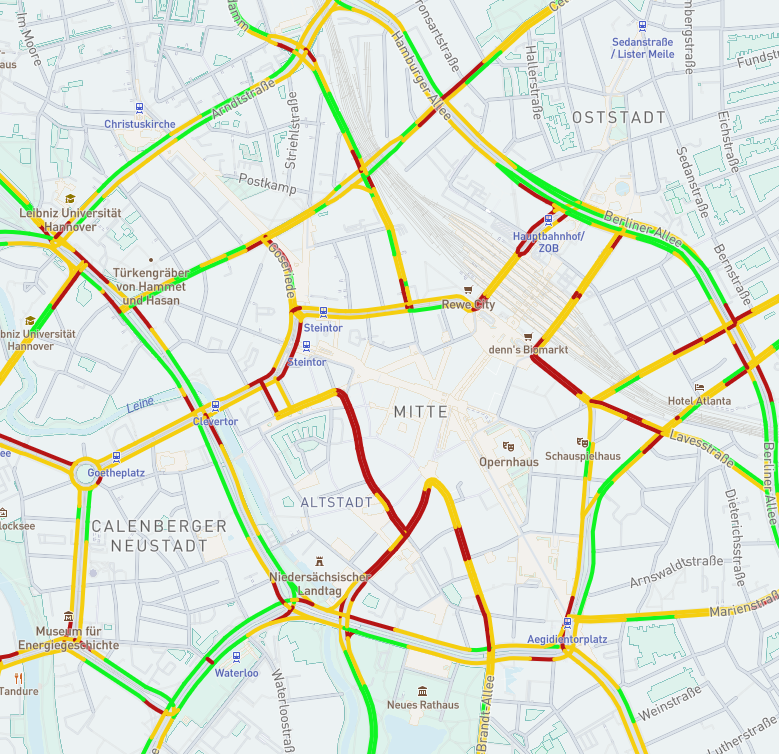
Anyone who calculates a route influences traffic by doing so. This feedback effect is the starting point for NUNAV.
A traffic forecast first describes the situation to be expected on a road at a later point in time. A route recommendation changes that situation: it brings additional vehicles onto specific roads. If forecasting and route assignment are considered separately, a recommendation can change its own basis. The free alternative route may then no longer be free when the recommended vehicles get there.
Neural networks at the core of NUNAV
Neural networks are used at the technical core of NUNAV. They determine the relationship between traffic demand and possible driving speeds. Put simply: which speed can be expected on a road segment when a certain demand arises there at a certain time?
This is decisive for the forecast. The speed measured right now does not yet tell you how fast a vehicle can pass that segment later.
Route coordination uses this relationship. For every new routing decision, NUNAV takes into account the trips already planned by other participating vehicles. Through the reservation procedure, their expected use of the road network feeds into further decisions.
“Reservation” does not mean an exclusive claim to a road. It is the computational consideration of a planned trip. This way, demand can be taken into account before it shows up as traffic at a measuring point.
AI also makes traffic reports usable
A second area of application is editorial traffic information, especially road closures.
Cities and municipalities still often publish such information as free text. People can understand a notice like “Hauptstraße will be closed inbound between Bahnhofstraße and Marktplatz from Monday”. A routing system needs clearly assigned road segments, directions of travel and validity periods.
This is where we use AI as well. The information has to be understood first and then transferred to the technical map system. Only then can it be taken into account in a route calculation.
The decisive connection
So AI helps NUNAV both to model traffic and to make information usable. The collaborative approach connects these foundations with route assignment: every further recommendation takes into account the demand that trips already planned create.
For the question “AI against congestion”, it is therefore less decisive whether AI is used somewhere. What decides is which task it takes on and how its results influence the distribution of traffic.